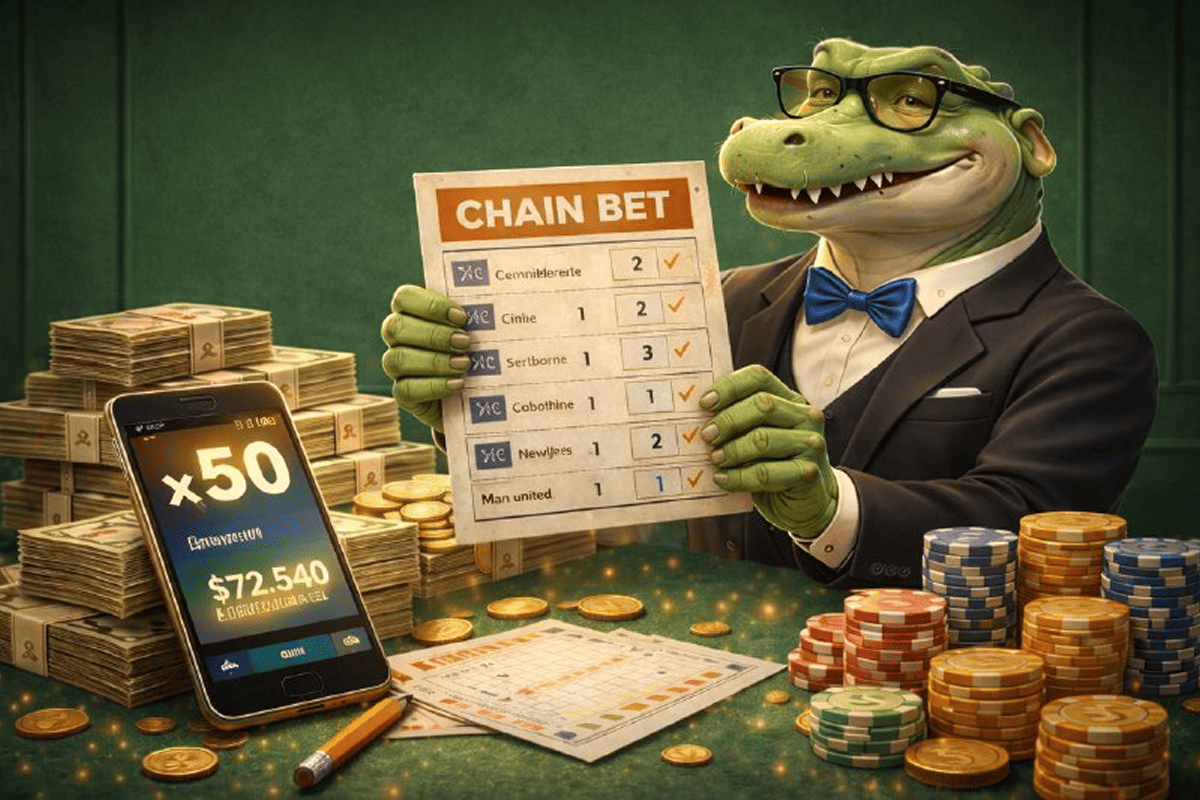
Alright, settle down. Samir here. I’ve seen more hopeful faces turn sour than a bad batch of dim sum at 12 AM. And usually, it’s because someone read a forum post about a “guaranteed” system. Today, we’re talking about chain bets. Yeah, I’ve heard the whispers, seen the guys at the rail with their notebooks, convinced they’ve cracked the code. Let me tell you, the only code I ever saw cracked was the one that got a high roller’s credit card declined. That was a fun night. But I digress. Let’s demystify this chain bet business, shall we?
Understanding Chain Bets
Definition of a Chain Bet
So, what exactly is a chain bet? In its simplest form, a chain bet is a series of single bets linked together, where the stake for each subsequent bet is determined by the winnings of the previous bet. Think of it like a domino effect, but with your money. If the first bet wins, a portion (or all) of those winnings becomes the stake for the second bet, and so on. If any bet in the chain loses, the entire chain breaks, and you lose everything you’ve staked up to that point. It’s a high-risk, high-reward strategy, often touted by folks who’ve clearly never had to explain a five-figure loss to a crying wife at the casino cage.
Takeaway: A chain bet links multiple single bets, with winnings from one fueling the next. Lose one, lose the chain. Simple.
Concept of a Chain Betting System
The concept behind a chain betting system is to leverage compounding wins to achieve a large payout from a relatively small initial stake. You’re essentially rolling your profits forward. It’s seductive, I get it. The idea of turning a few bucks into a fortune with a string of correct predictions. But remember, every additional link in that chain adds another point of failure. It’s like building a house of cards: impressive if it stands, devastating when it collapses. And trust me, I’ve seen more collapses than a cheap Vegas buffet table after a convention.
Takeaway: Chain betting aims for big wins from small stakes by compounding, but each step increases risk.
How Chain Bets Work
Rules of Chain Bets
The rules of chain bets aren’t set in stone like blackjack or roulette. They’re more of a framework you impose on your own betting. You decide the number of bets in the chain, the percentage of winnings to roll over, and the specific events you’re betting on. Most commonly, players choose events with relatively low odds, hoping to string together a series of ‘sure things.’ But in the pit, Samir knows there’s no such thing as a sure thing. If there was, I’d be on a yacht in the Mediterranean, not telling you this stuff.
Takeaway: You set your own rules for chain bets – number of legs, rollover amounts, and selections.
How Chain Bets are Calculated
Let’s break down the math, because this is where people usually get confused, or worse, overly optimistic. Say you start with a $100 stake for Bet 1. If Bet 1 wins and pays out $200, you now have $200. For Bet 2, you might decide to use all $200 as your stake, or maybe just a portion, say $150, pocketing the rest. If Bet 2 wins and pays $300, that $300 (or a chosen portion) becomes the stake for Bet 3. This continues until you either hit your target payout, or more commonly, one of your bets loses, and your chain breaks. It’s a simple multiplication game, but the house always has the edge, and the odds stack up against you with every additional link.
Takeaway: Winnings from one bet become the stake for the next, multiplying potential returns or losses.
Example of a Chain Bet
Let’s run through an example. You’re at the sports book, it’s 1 AM, and you’ve had a few too many complimentary drinks. You decide to start a chain bet with $50.
- Bet 1: Football match, Team A to win at odds of 2.00. You stake $50. If Team A wins, you get $100.
- Bet 2: You roll over the full $100 onto a basketball game, Team B to win at odds of 1.80. If Team B wins, you get $180.
- Bet 3: Feeling invincible, you roll over $150 (pocketing $30, smart move, for once) onto a horse race, Horse C to place at odds of 1.50. If Horse C places, you get $225.
Congratulations, you just turned $50 into $255 ($225 + $30 pocketed earlier). Now, imagine if Team B lost. That $100, and your original $50, gone. Poof. That’s the reality of it. I’ve seen guys sweat bullets over these chains, pacing the floor, looking like they’re about to have a coronary. Usually, it ends in tears, or a demand for another comped drink.
Takeaway: A successful chain multiplies your initial stake, but a single loss wipes out the entire accumulated amount.
Placing a Chain Bet
Steps to Place a Chain Bet
Placing a chain bet isn’t as complicated as some of these guys make it out to be. It’s really about discipline, which, let’s be honest, is usually the first thing to go when someone walks into a casino. Here’s the drill:
- Choose Your Events: Pick a series of events you want to bet on. Sports, elections, what have you. Just make sure they’re sequential or at least have results that come in one after another.
- Determine Your Initial Stake: How much are you willing to lose on the very first bet? This is crucial. Don’t bet more than you can afford to light on fire.
- Set Your Rollover Strategy: Decide how much of your winnings from each successful bet you’ll roll over to the next. All of it? A percentage? This is where your risk tolerance comes in.
- Place Bet 1: Make your first bet.
- Wait for the Result: This is the agonizing part.
- If Bet 1 Wins: Collect your winnings, apply your rollover strategy, and place Bet 2.
- If Bet 1 Loses: The chain is broken. Your initial stake is gone. Walk away, or start a new chain with new money (which I generally advise against, especially if you’re already tilting).
- Repeat Until Complete or Broken: Keep going until you’ve either completed your desired chain or, more likely, one of the legs fails.
I’ve seen players try to manage multiple chains at once. That’s when the real chaos starts. Papers flying, phones ringing, dealers looking at me like, “Samir, please make it stop.” Don’t be that guy.
Takeaway: Select events, define your stake and rollover, then execute each bet sequentially until the chain ends.
Strategies and Considerations for Chain Betting
Chain Betting Strategy Tips
Look, I’m not going to tell you there’s a foolproof strategy for chain betting. If there was, I wouldn’t be writing this – I’d be retired on a private island, sipping expensive cocktails. But if you insist on trying this, here are a few tips from someone who’s seen it all:
- Start Small: Your initial stake should be something you’re comfortable losing immediately. Don’t bet the rent money. Seriously. I’ve had to call security on guys trying to bet their car title.
- Limit the Chain Length: The more links in your chain, the higher the probability of one link breaking. Keep it short and sweet. Three to five bets max, if you’re feeling lucky. Any more and you’re just asking for trouble.
- Do Your Homework: Don’t just pick random events. Research your selections. Understand the odds, the teams, the conditions. Ignorance is expensive in this business.
- Vary Your Rollover: You don’t have to roll over 100% of your winnings every time. Consider taking some profit after a successful leg or two. It reduces your potential final payout, but it also reduces your overall risk. A bird in the hand, as they say, is worth two in the bush, especially when those two birds are flying over a casino floor at 4 AM.
- Set a Stop-Loss and a Target: Before you even place your first bet, decide how much you’re willing to lose in total, and what your target payout is. Stick to it. This is where most people fail. They get greedy, or they chase losses. Both are recipes for disaster.
Takeaway: Begin with a small stake, keep chains short, research your picks, consider partial rollovers, and set strict limits.
Advantages of Chain Bets
Alright, let’s talk about why people bother with these things. There are a couple of perceived advantages, if you squint hard enough.
- High Potential Returns: This is the big one. A small initial stake can theoretically snowball into a significant payout if all your bets hit. It’s the lottery ticket dream, but with a bit more ‘strategy’ involved.
- Excitement Factor: Let’s be honest, watching a chain bet unfold is thrilling. Each successful leg builds the tension. It’s like watching a high-stakes poker hand, but spread out over hours or even days.
I’ve seen the euphoria when a chain hits. It’s a beautiful thing. For about five minutes. Then they usually try to run another chain, and that’s when I start preparing for the inevitable. The casino always wins in the end, Samir always says.
Takeaway: Chain bets offer high reward potential and an exciting betting experience.
Disadvantages of Chain Bets
Now, for the cold, hard reality. The disadvantages of chain bets are significant and often overlooked by the starry-eyed hopefuls.
- High Risk of Loss: This is the elephant in the room. A single incorrect prediction at any point in the chain means you lose everything you’ve staked on that chain. The probability of success decreases exponentially with each additional bet.
- Compounding House Edge: With every bet you place, the house edge is applied. In a chain bet, you’re essentially exposing your winnings to the house edge multiple times. It’s like paying commission on your winnings over and over again.
- Emotional Rollercoaster: The highs are high, but the lows are brutal. I’ve seen grown men cry over a missed penalty kick that broke their chain. It’s not good for your blood pressure, or your bank account.
- Requires Patience and Discipline: You need to wait for results, manage your bankroll, and resist the urge to chase losses or get overly confident. These are traits rarely found in the average casino patron at 2 AM.
Look, I’ve seen more bad beats than I can count. A chain bet just multiplies the chances of one of those bad beats ending your run. It’s a game of probabilities, and the probabilities are never truly on your side.
Takeaway: Chain bets carry extremely high risk due to compounding house edge, leading to frequent total losses and emotional strain.
Frequently Asked Questions about Chain Bets
Are chain bets legal?
Yes, chain bets themselves are generally legal. They’re just a specific way of structuring a series of legal wagers. You’re simply placing one bet after another, using winnings from previous bets. The legality depends on the legality of betting in your jurisdiction and the specific sportsbooks or platforms you use.
Can I place a chain bet on any sport?
Theoretically, yes. You can chain bets across different sports, or even different types of events, as long as you can place individual wagers on them. The challenge is finding enough suitable events that align with your strategy and timing.
What’s the difference between a chain bet and an accumulator (parlay)?
This is a common one. An accumulator, or parlay, is a single bet where all selections must win for the parlay to pay out. The stake is fixed at the beginning. In a chain bet, you are placing individual bets sequentially, and the stake for each subsequent bet can change based on the winnings (or your decision to roll over a portion). If one leg of a parlay loses, the entire parlay loses. If one leg of a chain bet loses, the chain breaks, but you might have already pocketed some winnings from earlier legs if you chose to. It’s a subtle but important distinction that most newbies miss.
Is chain betting a good strategy for beginners?
Absolutely not. If you’re new to betting, stick to single bets. Understand how odds work, how to manage your bankroll, and how to control your emotions. Chain betting is a fast track to losing your shirt, and probably your pants too. I’ve seen beginners try to jump straight into these complex systems, and it usually ends with them looking utterly bewildered when their carefully constructed ‘system’ implodes. Take it from Samir, learn to walk before you try to run a marathon in a casino. The house has been running marathons for centuries.
What are the ‘top mistakes’ people make with chain bets?
Oh, where do I even start? I’ve seen it all. The biggest mistakes, the ones that make me want to pull my hair out, are:
- Getting Greedy: Rolling over 100% of winnings every single time, even when the odds are getting longer, and the chain is getting ridiculously long. They see the potential big number and forget about the minuscule probability.
- Chasing Losses: Breaking a chain and immediately starting a new, bigger one to ‘get back’ what they lost. This is a one-way ticket to financial ruin, and I’ve had to intervene in more than a few of these situations.
- Ignoring Research: Just picking teams or horses based on a gut feeling or because they ‘like the name.’ That’s not strategy, that’s throwing money into a black hole.
- Lack of Discipline: Not sticking to their predetermined stake, rollover, stop-loss, or target. The moment emotions take over, the game is lost. I’ve seen guys plan meticulously for weeks, then throw it all out the window after their first win.
It’s like watching a train wreck in slow motion. You want to yell at them, but they never listen. Until they’re broke, that is.
So, there you have it. Chain bets. Are they a path to riches? For a lucky few, maybe. For the vast majority, they’re just another way to hand your money over to the house, albeit with a bit more suspense. Samir has seen enough of these ‘systems’ to know that the only sure bet in a casino is that the house always has an edge. Play smart, play responsibly, and for god’s sake, don’t bet the farm on a six-leg chain. I’ve got enough drama to deal with on the floor without adding your financial meltdown to my shift report. Now go on, get out of here, and try not to do anything stupid.