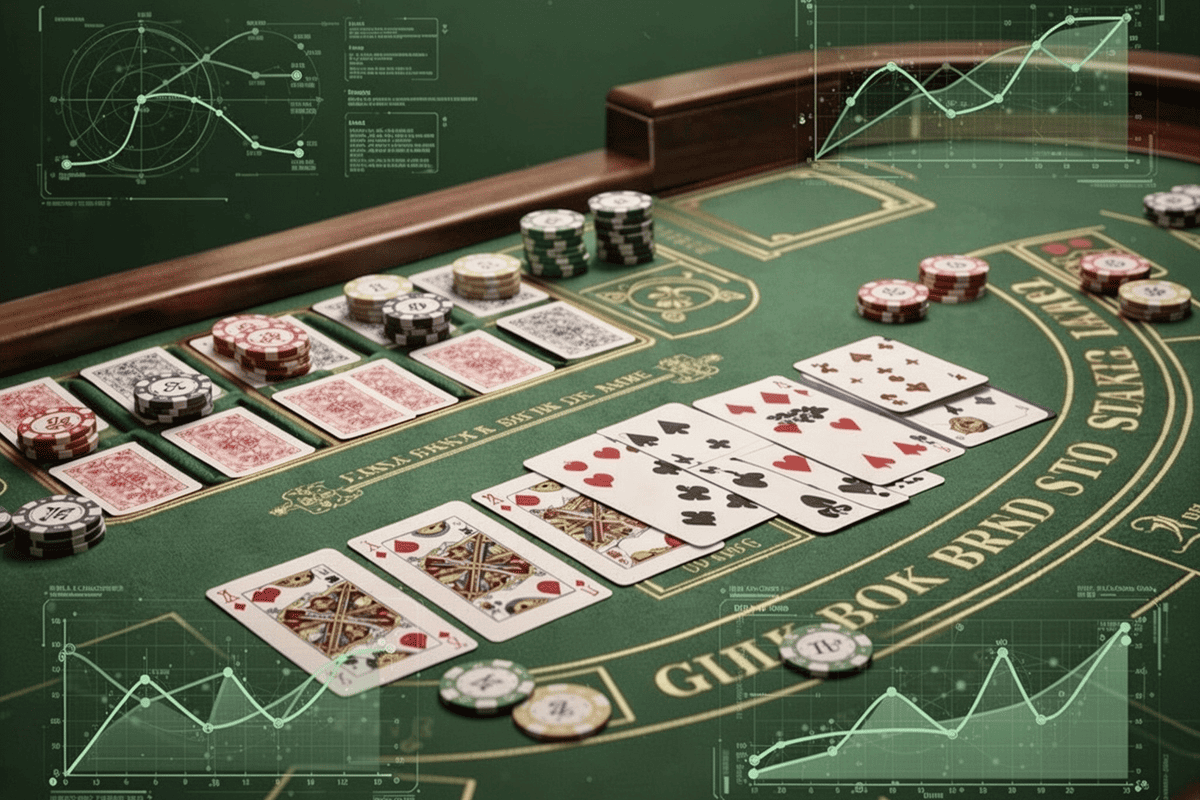
Let me tell you, there’s nothing quite like 3 AM on a Monday in a high-limit room. The air is thick with stale cigar smoke and desperation. I’ve seen grown men, titans of industry, turn into blubbering infants over a bad beat. I’ve watched others, cool as a cucumber, systematically drain a table while the dealer wondered if they’d miscounted. That second type? They weren’t lucky. They were counting cards. And if you’re reading this, you’re probably looking to join their ranks. Good for you. Just don’t expect me to look the other way when you’re doing it on my floor.
My name is Samir, and I’ve spent more than a decade watching every trick in the book, and inventing a few new ones to counteract them. Today, we’re going to talk about the Zen Count blackjack strategy. It’s a solid system, one of the better balanced counts out there, and if you put in the work, it can give you an edge. But remember, an edge isn’t a guarantee. It’s just a better chance. And in this game, that’s all you can ever really ask for.
Understanding Card Counting
Before we dive into the Zen Count, let’s get something straight. Card counting isn’t magic. It’s not about memorizing every card that’s been played. If you think that, you’re already behind. It’s about tracking the ratio of high cards to low cards left in the shoe. That’s it. Simple concept, surprisingly difficult to execute under pressure, especially when the pit boss (that was me) is breathing down your neck, and the cocktail waitress just spilled a tray of drinks all over the guy who just lost his house.
Basics of Card Counting
At its core, card counting assigns a numerical value to each card. Low cards (2s, 3s, 4s, 5s, 6s) are good for the player because they reduce the dealer’s chances of busting and increase your chances of getting a blackjack or improving a stiff hand. High cards (10s, Jacks, Queens, Kings, Aces) are bad for the player, but good for you if they’re still in the shoe, because they increase the likelihood of getting a 10-value card or an Ace, which favors the player on splits, doubles, and blackjacks. When more high cards are left in the deck, the player’s advantage increases. When more low cards are left, the house’s advantage increases.
Your job, as a card counter, is to keep a running tally of these values. This tally helps you determine when the deck is “rich” in high cards (good for you) or “poor” (bad for you). It’s not about knowing what card is next. It’s about knowing the probability of what card is next. Subtle, but crucial, difference.
Takeaway: Card counting is about probabilities, not clairvoyance.
Running Counts versus True Counts in Balanced Counting Systems
This is where a lot of rookies screw up. They get a decent running count and think they’re hot stuff. The running count is just your cumulative tally of card values. It’s what you keep in your head as cards fly out of the shoe. But a running count alone isn’t enough because it doesn’t account for how many decks are left to be played. A running count of +10 in a single-deck game is vastly different from a running count of +10 in an eight-deck shoe where only one deck has been dealt.
That’s where the true count comes in. The true count adjusts the running count based on the estimated number of decks remaining. You divide your running count by the estimated number of decks left. This gives you a more accurate picture of your actual advantage. If you don’t convert to a true count, you’re essentially driving blind, or worse, making big bets when the advantage isn’t really there. I’ve seen guys get busted out because they thought a +8 running count in an eight-deck shoe was a golden ticket. It wasn’t. It was a 0 true count.
Takeaway: Running count is raw data; true count is actionable intelligence. Always use the true count.
Advantages of Card Counting Systems
The primary advantage of any effective card counting system is simple: it shifts the odds. Blackjack, by its very nature, is designed to favor the house. Card counting, when executed correctly, can give the player a slight edge, typically between 0.5% and 2%. Now, 0.5% might not sound like much, but over hundreds, thousands of hands, it adds up. It’s the difference between slowly bleeding money and slowly making it. It allows you to make better decisions on when to hit, stand, double, or split, and most importantly, when to increase your bets. It’s not about winning every hand; it’s about winning more money on the hands you have an advantage on.
Takeaway: Card counting provides a statistical edge, turning a house game into a player’s opportunity.
The Zen Count System: Specifics and Tag Values
Alright, let’s get down to brass tacks: the Zen Count blackjack strategy. This is a balanced counting system, meaning that if you count through an entire deck, your final count will be zero. This is a good thing, because it indicates the system is designed to give an accurate representation of the deck’s composition. It’s a level 2 count, which means it uses more than just +1, 0, -1 values, making it more accurate than simpler systems like Hi-Lo, but also a bit more demanding on your mental horsepower.
When I was on the floor, I could spot the Hi-Lo guys a mile away. They were easier to track. The Zen counters? They were a bit more elusive, a bit smoother. They had to be, because they were doing more complex math in their heads while trying to look bored. It’s not for the faint of heart, but if you master it, you’ll have a more precise read on the deck.
Card Tag Values in Zen Count
Here’s the breakdown of the Zen Count values. Pay attention, because this is the core of the system:
- Cards 2, 3: +1
- Cards 4, 5, 6: +2
- Card 7: +1
- Card 8: 0
- Card 9: 0
- Cards 10, J, Q, K: -2
- Ace: -1
Notice the spread? You’ve got +2 for those crucial 4s, 5s, and 6s, and a -2 for the 10-value cards. Aces are also a negative, which is where some beginners get tripped up, but remember, Aces are great for the player, so when they’re gone, your advantage decreases. The 7s getting a +1 and 8s/9s getting a 0 are what make this a level 2 count and give it its precision. It’s not just about high vs. low; it’s about specific impact on the game.
Practice these values until they’re second nature. Get a deck of cards, flip them over, and just count. Do it while you’re watching TV. Do it while you’re waiting for your coffee. Do it until you can rattle off the running count without thinking, even when your significant other is asking you to take out the trash and the dog is barking at a squirrel. That’s what it takes to do this under casino lights.
Takeaway: Master the Zen Count tag values; they are your eyes and ears at the table.
Comparing Zen Count with Other Strategies
There are more card counting systems out there than there are excuses for losing your shirt at the craps table. But they generally fall into a few categories. The Zen Count sits comfortably in the middle-to-advanced tier. It’s not as simple as Hi-Lo, but it’s not as complex as some of the three-level or side-count systems that require you to be a human supercomputer.
Zen Count for Deviations vs. Hi-Lo
The most common system you’ll hear about, especially from beginners, is Hi-Lo. It’s simple: 2-6 are +1, 10-A are -1, and 7-9 are 0. Easy to learn, easy to implement. But that simplicity comes at a cost: accuracy. Hi-Lo is good, but the Zen Count is better when it comes to making playing deviations. Playing deviations are when you alter your basic strategy decisions (like hitting a 12 against a dealer’s 2) based on the true count. Because the Zen Count is more accurate, its recommendations for these deviations are more precise, giving you a slightly larger edge.
For example, in Hi-Lo, you might be told to stand on a 12 against a dealer’s 2 at a true count of +3. With Zen Count, that threshold might be slightly different, or you might find that you can hit that 12 at a +2 true count against a 3. These small differences, over time, add up. It’s like the difference between a decent chef and a Michelin-star chef. Both can cook, but one has a finer touch that makes all the difference.
Takeaway: Zen Count offers superior accuracy for playing deviations compared to simpler systems like Hi-Lo.
Design and Selection of Card Counting Systems
When you’re picking a system, you’re balancing two things: power and ease of use. Power refers to how accurately the system correlates with player advantage. Ease of use is, well, how easy it is to keep track of. Zen Count is a solid choice because it offers a good balance. It’s more powerful than Hi-Lo, meaning it gives you a better estimate of your edge and better deviation advice, but it’s not so complex that you’ll be fumbling with the numbers while the dealer is asking if you want insurance.
Ultimately, the best system is the one you can execute flawlessly under pressure. I’ve seen guys with incredibly complex systems get flustered after a few bad hands and start making mistakes. A simpler system executed perfectly is always better than a powerful system executed poorly. So, while Zen Count is powerful, make sure you can handle it. If you can’t, start with Hi-Lo, get comfortable, and then work your way up. There’s no shame in starting small. There is shame in losing money because you were too proud to practice.
Takeaway: Choose a card counting system that balances power with your ability to execute it flawlessly under pressure.
Advanced Card Counting Concepts
So you’ve got the Zen Count values down, you understand true count. Great. But that’s just the foundation. To really make this work, you need to understand how to leverage that information. This isn’t just about knowing the numbers; it’s about knowing how to play the game, and more importantly, how to play the casino.
Back-counting
Back-counting, or ‘wonging’ as it’s sometimes called (after the legendary Stanford Wong), is a strategy where you stand behind a table, keep a running count, and only sit down to play when the true count reaches a favorable level. This is a very effective way to minimize your time playing at a disadvantage. Instead of grinding through negative counts, you wait for the storm to pass and only step in when the sun is shining.
Now, I’ll tell you, as a pit boss, back-counters were a pain. They didn’t play enough hands to generate comps, they tied up seats, and they were clearly only there when the odds were good. We’d spot them lurking, nursing a free soda, and if they suddenly started playing big, we’d be on them. It’s a powerful strategy, but it’s also a red flag to casino personnel. You need to be subtle. Don’t make it obvious you’re waiting. Chat with the players, pretend to be interested in the game, act like you’re just passing time. And when you do sit down, don’t immediately drop a huge bet. Ease into it, then ramp up.
Takeaway: Back-counting can significantly increase your edge by only playing favorable shoes, but demands extreme stealth.
Ranging Bet Sizes
This is where the rubber meets the road, folks. The whole point of card counting is to know when you have an advantage, and then to bet more when you do. If you’re betting the same amount every hand, whether the true count is -5 or +5, you’re just a glorified basic strategy player, and you’ll still lose in the long run. Your bet spread is critical.
A common bet spread might be 1 unit at a neutral or negative count, and then slowly increasing to 2, 3, 5, or even 10 units as the true count rises. The higher the true count, the more you bet. But here’s the catch: a wide bet spread is the easiest way for a pit boss like me to spot a counter. If you go from betting $25 to $500 in two hands, you’re practically screaming, “I’m counting cards, please kick me out!”
You need to make your bet spread look natural. Maybe you got a big win, so you pressed your bet. Maybe you’re feeling lucky. Maybe you’re just an impulsive idiot. Casinos understand impulsive idiots. They don’t understand logical, systematic betting increases tied to the deck composition. Keep your spread reasonable, or at least disguised. Don’t be afraid to flat bet a few hands at a high count if you think you’re getting heat. It’s better to miss a little edge than to get barred.
Takeaway: Vary your bet sizes proportional to the true count, but always disguise your spread to avoid detection.
Expected Profit
Let’s talk about money. Everyone wants to know how much they can make. And this is where I tell you to temper your expectations. Card counting isn’t a get-rich-quick scheme. It’s a grind. Your expected profit depends on several factors: your average bet size, the number of hands you play per hour, and your edge. Even with a 1% edge, if you’re only betting $10 a hand, you’re not going to retire early.
Let’s say you have a 1% edge, and you average $50 per hand in action (meaning the average of all your bets across all true counts). If you play 100 hands an hour, that’s $5,000 in action, for an expected profit of $50 per hour. Sounds good, right? But that’s an expected profit. Variance is a cruel mistress. You can have hours, even days, where you do everything right and still lose. That’s why you need a bankroll, and you need to be prepared for the swings. Don’t go into this thinking every session will be a winner. It won’t. I’ve seen guys with perfect counts lose for three days straight before hitting a hot streak. It tests your resolve, and your bankroll.
Takeaway: Expected profit is a long-term average; prepare for significant short-term variance and manage your bankroll accordingly.
Top Mistakes: From the Pit Boss’s View
Alright, listen up. I’ve seen every mistake in the book. And I’ve seen the same mistakes repeated by otherwise smart people who think they’re too clever for the casino. Here’s a list of how to get yourself kicked out, or worse, lose your shirt.
- Counting Too Obviously: This is number one. You’re sitting there, lips moving slightly, eyes darting from cards to the discard tray, then back to your chips, trying to calculate the true count. Or maybe you’re making exaggerated movements when you change your bet size. When I walked by, I wasn’t looking at your chips; I was looking at your face, your hands, your patterns. If you’re counting, act like you’re not interested in the game at all. Act bored. Act drunk. Anything but “intensely focused.”
- Ignoring Basic Strategy Deviations: You’ve mastered the Zen Count, you know the true count, but then you get cold feet and stick to basic strategy when the count tells you to deviate. What’s the point then? The advantage comes from these deviations. If the true count says hit that hard 16 against a dealer’s 10, you hit it. Don’t second-guess the math because you’re scared of busting.
- Poor Bankroll Management: Thinking you can start with $500 and turn it into a fortune. Card counting is a long-term game. You need a significant bankroll to withstand the inevitable downswings. If you’re betting rent money, you’re not counting; you’re gambling, and you will lose. I’ve watched too many guys blow through their entire bankroll in a single bad session because they couldn’t handle the variance.
- Not Converting to True Count Accurately: As I said before, this is a killer. A high running count in a multi-deck shoe that’s barely been played means nothing. You need to be able to accurately estimate the remaining decks and convert to a true count. If you can’t do this quickly and accurately, you’re just guessing.
- Playing Too Long or Too Aggressively at One Table: You hit a hot shoe, the money is flowing, and you feel invincible. So you stay there, betting big, winning big. Great for a while. But it also means you’re drawing attention. Pit bosses aren’t stupid. If one player is consistently winning and betting big at a particular table, we notice. Get in, get out. Move tables. Change casinos. Don’t overstay your welcome.
- Drinking Too Much: Oh, this one is classic. Free drinks flow freely in the casino. And if you’re trying to keep a level 2 count in your head while you’re three whiskeys deep? Forget about it. You’ll be counting backwards, betting when you shouldn’t, and making a fool of yourself. Save the celebration for after you’ve cashed out.
Takeaway: Avoid these common pitfalls; they’re a fast track to losing your edge and getting the boot.
Samir’s Final Word: The Grind is Real
So, you want to be a card counter. You’ve read up on the Zen Count blackjack strategy, you’ve practiced the tags, you understand the true count. Good. That’s the first step. But the casino floor isn’t a textbook. It’s a battlefield. It’s loud, it’s distracting, and every single person working there, from the dealer to the cocktail waitress to the pit boss (that was me), is subtly, or not so subtly, watching you.
This isn’t a game for the impatient or the easily flustered. You’ll have bad runs. You’ll make mistakes. You’ll get heat from the floor. But if you’re disciplined, if you practice relentlessly, and if you can keep your cool under pressure, the Zen Count can absolutely give you an edge. It’s a tool, a sharp one, but like any tool, its effectiveness depends entirely on the skill of the person wielding it.
Go practice. Get good. And if I ever see you on the floor, doing what I know you’re doing, just give me a nod. I won’t say anything. But I’ll be watching. Always watching.